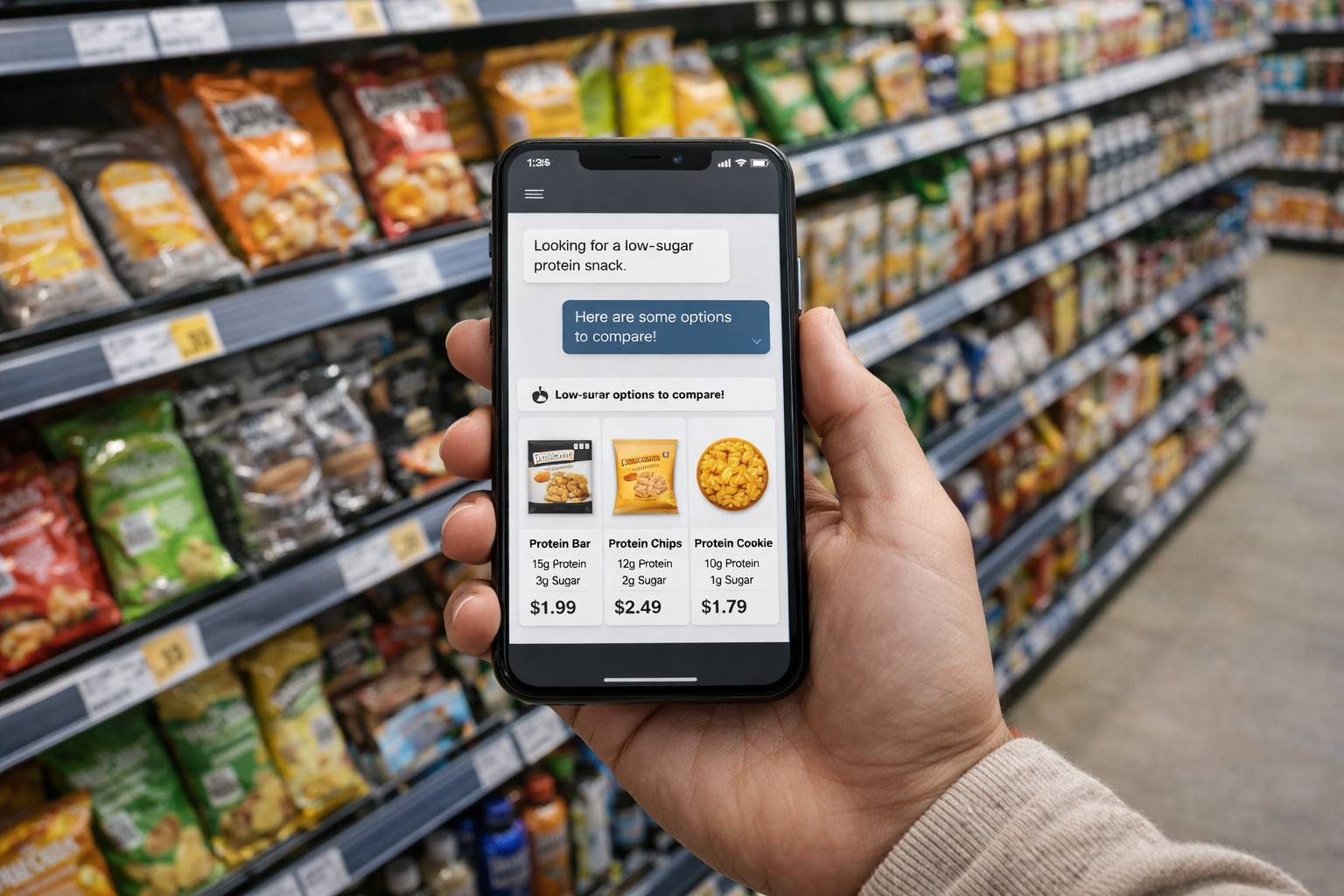
In retail, product discovery now happens across different touchpoints. The store still matters, but today the customer also comes into contact with a product through online search, social media, digital promotions, automatic suggestions and, increasingly, artificial intelligence tools. For distributors and retail chains, this means that in addition to managing the shelf well, they also need to make the product visible, understandable and convincing along a much broader discovery journey.
Key data
How product discovery is changing:
- 45% of consumers discover brands through advertising and in-store displays
- 34% use online search, while 31% discover them through social advertising and influencers
- 23% already use generative AI in the product discovery and exploration phase while shopping
- 21% use AI as support to receive product recommendations
- 15% say they have purchased based on AI suggestions
- 10% have already used AI agents to buy products directly on their behalf
The change, therefore, concerns the way consumers discover, compare and select products. For retail chains and distributors, the challenge is understanding how to make physical display, promotion, product content and new recommendation tools work together (especially systems based on generative and agentic AI).
Beyond the current data (which may differ depending on who conducts the surveys, where and how), it seems inevitable that the use of AI for shopping will involve an increasingly large audience in the coming years.
In particular, in the food and beverage sector, AI can have a decisive impact on several aspects linked to regular shopping, strengthening its adoption by consumers: convenience and time saving, affordability, dietary needs, choices linked to health and wellbeing, personal tastes, consumption habits, as well as the discovery of new products and alternatives consistent with individual preferences.
The shelf remains central, but it is no longer self-sufficient
The most recent data show that the physical store still plays a very strong role in brand and product discovery. Among the main brand discovery channels are advertising and in-store displays, both at 45%, followed by promotions, discounts and coupons at 35%, free samples at 27% and in-store demonstrations at 24% (EY data, Consumer & Retail Outlook, March 2026).
At the same time, however, digital channels are quickly catching up: online search accounts for 34%, social media advertising for 31%, influencers for 31%, online recommendations for 17% and livestream commerce for 8%. The picture that emerges is consistent with a physical store that remains decisive, but product discovery has already become hybrid.
For retail, this changes the way commercial effectiveness is interpreted. Until recently, visibility depended mainly on positioning, display and promotional materials at the point of sale. Today, however, the customer may notice a product on the shelf, look into it online, come across it again on social media, compare it through an AI assistant and decide to purchase it later. In other words, the discovery journey is no longer linear and does not end within the store's physical space.
AI enters the search and recommendation phase
The most interesting development is that artificial intelligence is entering directly into the search, selection and recommendation phase. A growing share of consumers already use AI to identify, research or receive suggestions for products to buy. It is therefore no longer a marginal or experimental tool, but is beginning to become a consolidated habit across different types of consumers.
According to EY's survey, 21% of consumers already use AI to identify or receive product recommendations, 19% use it to look for discounts and 15% say they have purchased items based on AI-generated suggestions. These are significant figures because they show that AI - in addition to being an informational support - is starting to have a concrete impact on the commercial visibility of products.
Considering these factors, the value and function of the product page also changes. If the consumer discovers an item through AI tools or search engines based on virtual assistants, clear descriptions, readable attributes, consistent data and easily interpretable information become even more important (for both the human reader and the machine). This applies to both retailers and suppliers. A product with weak or poorly structured content may in fact be less competitive not only in traditional search, but also in the new discovery paths mediated by AI.
From recommendation to action: AI agents begin to buy
The most significant leap concerns the use of intelligent agents: AI no longer only suggests, but also begins to act. EY reports that 84% of respondents have used AI in the last six months and 16% say they have already used AI systems that operate without direct human intervention.
Even more interesting for retail is the fact that 10% have already used AI agents to purchase products on their behalf, 11% use them for automatic cart refill or recurring purchases, and 36% say they are open to letting AI automatically apply the best available discount or promotion at checkout (without the customer having to manually search for coupons, promo codes or applicable offers).
For distributors and retail chains, this opens a new phase. If a growing share of consumers delegates parts of the purchasing process to AI, competition will no longer concern only shelf price or the quality of visual merchandising, but also the ability to be selected by automatic systems. This makes product data quality, promotional clarity, information consistency and the availability of content suitable for semantic reading even more important.
How interaction between consumers and AI is changing in product discovery
The recent Deloitte report (Emerging Retail and Consumer Trends, Q1 2026) helps interpret the change not only from a strategic point of view, but also through some figures showing how interaction between consumers and artificial intelligence is already entering shopping practices.
The first step concerns the discovery phase: 23% of consumers already use generative AI to search for products while shopping and, among them, 35% use it to speed up the purchasing process. In this sense, AI is beginning to become a concrete tool for orientation and selection, not just an informational support.
A second element concerns the retailer's owned channels. Deloitte notes that 80% of customers prefer buying from retailers that offer personalised search and shopping experiences. This figure reinforces the importance of AI assistants integrated into websites or apps, capable of turning navigation into a more guided, more relevant and more consistent interaction with the available assortment.
The transformation also emerges outside the touchpoints controlled by brands. According to Deloitte's report, during the 2025 holiday season generative AI tools generated a 693% increase in traffic to retail operators' websites compared to the previous year. This is a very strong signal: product discovery is increasingly beginning to pass through AI interfaces that act as filters, comparators and guides towards the retailer.
The next step concerns conversion. AI-assisted shoppers are 9 times more likely to convert than those using traditional channels, while 24% of consumers expect to make AI shopping their default mode in 2026. These are figures suggesting that AI may begin to profoundly redesign the path leading to purchase.
There is, however, still an important limit: trust. Deloitte highlights that only 14% of Americans currently trust AI enough to let it place orders on their behalf. This means that the consumer-AI relationship is already real, but still evolving. For retailers and distributors, the key point is understanding how to prepare for a context in which product discovery, recommendation and conversion will increasingly be mediated by intelligent tools.
External tools and proprietary tools: how interaction with AI is evolving
To understand how product discovery is really changing, it is useful to distinguish between two families of tools that are already accessible on a large scale: on one side general AI platforms, external to brands, which help consumers search, compare and orient themselves; on the other side proprietary tools made available by retailers and marketplaces on their own websites and apps.
1. Tools external to brands: general AI, conversational and agentic engines
General platforms are becoming an increasingly relevant access point for product discovery. In this case, it is worth distinguishing between conversational AI (chat-based, already widely used) and agentic AI (with autonomous action capabilities, a field that is not yet fully mature but is evolving rapidly, with consequences for both physical and online shopping):
- Conversational AI: it talks, interprets needs, compares alternatives, summarises reviews and suggests options. In this case it helps the consumer decide, it does not directly carry out the purchase but can take the user directly from the chat to a product page or to an order and payment page. For example, OpenAI has recently strengthened shopping functions in ChatGPT, which now allows users to explore products in chat, refine results in conversation, compare side-by-side options and upload images to find similar items.
- AI agent: beyond recommending, it can perform actions or get very close to action. For example, OpenAI is gradually developing and rolling out the Agentic Commerce Protocol precisely to make the link between product discovery and purchase paths more structured. In addition, general-purpose agentic AI tools capable of using browsers, PCs and phones to carry out more operational activities are also gaining ground. Among the best-known examples are OpenAI Operator, which can browse the web, fill in forms and carry out tasks such as online grocery shopping; Claude, which through its computer use function can control browser, mouse, keyboard and screen and receive tasks from a phone via Dispatch; and Google DeepMind's Project Mariner, designed to automate browser-based tasks such as research, data entry and assisted shopping. These are still early-stage or research tools, however, with clear limitations in terms of reliability and security: for this reason, in the near future it is reasonable to expect more mature solutions, more controllable and better integrated with payment systems and retailers' processes.
2. Proprietary tools: AI integrated into websites, apps and marketplaces
Alongside general platforms, proprietary AI tools are growing, meaning tools integrated directly into touchpoints controlled by the retailer or marketplace. Here the objective is to guide navigation better, personalise search and, in some cases, accompany the user all the way to purchase or reordering. This is the so-called "controlled channel", meaning the competitive advantage of those able to manage product discovery within their own digital ecosystem.
- Proprietary conversational assistant: it helps users find and compare products, build lists and receive personalised recommendations - within the offer of a specific retail operator. For example, Walmart presents Sparky as an AI assistant integrated into its app, capable of helping customers in various ways: product search, suggestions, aisle-organised lists and tools to find items in the store.
- Proprietary AI agent: it can carry out operational steps, with greater autonomy. For example, Amazon describes Rufus as an assistant capable not only of answering questions and comparing products, but also of adding items to the cart, finding deals, tracking price, activating alerts and using the Auto Buy function to purchase automatically when a product reaches the set price. Proprietary agentic AI does not concern online retail only: it is also starting to find applications in chains with physical stores, especially as a tool supporting product search, shopping planning and integration between apps, stores and pickup or delivery services. For now, however, the most concrete cases are still those in which AI assists and accelerates the purchasing path, rather than replacing it with full autonomy.
For brands, distributors and retail chains, this distinction matters because it changes the logic of commercial visibility. With tools external to brands, the product must be clear, complete and consistent enough to stand out within a general conversation. With proprietary tools, on the other hand, the challenge is to use AI to improve search, personalisation, conversion and repurchase within one's own ecosystem.
Another important signal concerns personalisation. Deloitte's report recalls recent studies according to which 80% of customers prefer retailers that offer personalised search and shopping experiences. This is relevant because it helps explain why AI assistants integrated into retailers' websites and apps are taking on an increasingly important role: not only as support tools, but as interfaces capable of guiding product discovery in a more targeted way and in line with the customer's profile.
Price, promotions and private label remain decisive
The fact that product discovery is evolving does not mean that traditional levers have lost weight. On the contrary, they continue to matter greatly. A study by the Zappi platform shows that 70% of consumers consider price or value the main driver of choice when buying food and beverages. 46% use coupons or promotions, 40% switch to private label for reasons linked to the perceived quality-price ratio, 38% buy only essentials and 34% buy fewer items to offset rising prices (Source: Zappi, CPG-Mega Trends Report, March 2026).
Moreover, those buying only industrial brands have fallen from 21% to 10%, while 66% today buy a mix of brands and private label. Product discovery continues to be filtered by perceived convenience, price clarity and assortment credibility, regardless of the channel (physical, digital or mixed) or the use of AI tools.
In practice, AI may expand discovery channels, but it does not erase the centrality of "value for money". This is particularly relevant for distributors and chains working on private label, assortment reorganisation and promotional policy. The objective is to communicate product value and justify price (both for premium products and for more conventional ones).
Beyond price: gratification, wellness and innovation also work
On the wellness front, Circana estimates that consumers with a consistent approach to health and diet quality account for around 40% of total sales across retail and foodservice in the United States.
Innovation also continues to matter. In Europe, for example, Innova Market Insights reports a 52% increase in new food & beverage launches with digestive health claims between 2024 and 2025, while globally launches with hydration claims show 18% year-on-year growth.
No less important is the gratification component. According to Innova, 60% of consumers globally prefer exploring something new when looking for indulgence, while 74% turn to food and beverages to improve their mood when dealing with stressful situations.
Overall, these figures show that retail growth is not driven only by affordability, but also by purchase motivations linked to wellbeing, functionality, gratification, experience and identity.
In this scenario, AI can strengthen product discovery precisely because it is able to take into account different purchase motivations and translate them into more relevant and personalised suggestions.
In commercial terms, this means that the most effective product discovery is played out on two levels: on one side affordability and clarity of value, on the other the ability to intercept more emotional or aspirational purchase motivations.
A change in perspective
Taken together, these figures suggest a change in perspective. Product discovery depends increasingly on how an item is described, promoted, recommended and found again across the different environments (physical and digital) in which consumers now move.
Different elements coexist in determining the path from choice/discovery to purchase: shelf layout and in-store strategies (promotions, loyalty programmes, marketing initiatives), alongside product page quality and presence across digital channels, including the preparation of data for the new search and selection paths mediated by AI.